
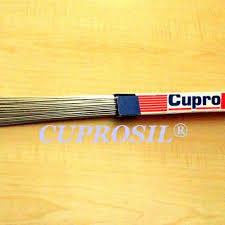
Description
🔬 Technical Data: Cupro-Silver (Phos-Copper) Rods
These alloys, such as those in the CUPROSIL P-Series (similar to Harris Stay-Silv), are primarily used for joining copper to copper.
| Alloy Grade (Example) | Nominal Composition | Solidus Temperature | Liquidus Temperature | AWS Classification | Key Property / Use |
| CUPROSIL 5P | 5% Ag, 6% P, 89% Cu | 643^C
(1190^F) |
815^C
(1500^F) |
BCuP-3 | Good flow, handles slightly wider gaps. Self-fluxing on copper. |
| CUPROSIL 15P | 15% Ag, 5% P, 80% Cu | 643^C
(1190^F) |
802^C
(1475^F) |
BCuP-5 | Highest ductility in the Phos-Copper series. Best for vibration/thermal cycling. Self-fluxing on copper. |
Key Technical Notes (Phos-Copper Type):
-
Flux: Self-fluxing on copper; Flux is required for brass, bronze, and dissimilar metals.
-
Not for Steel: Not suitable for ferrous metals (steel/iron) as the phosphorus causes brittle joints.
| Alloy Grade (Example) | Nominal Composition (Ag, Cu, Zn, Others) | Solidus Temperature | Liquidus Temperature | AWS Classification | Key Property / Use |
| CUPROSIL 45 | 45% Ag, 30% Cu, 25% Zn | 670^C
(1238^F) |
740^C
(1364^F) |
BAg-5 | General purpose, cadmium-free. Excellent for brass, copper, and mild steel. |
| CUPROSIL 56 | 56% Ag, 22% Cu, 17% Zn, 5% Sn | 620^C
(1148^F) |
650^C
(1202^F) |
BAg-7 | Lowest working temperature. Excellent for stainless steel and food/medical equipment (Cadmium-free). |
| CUPROSIL 43 (Cd-Bearing) | 43% Ag, 16% Cu, 20% Zn, 21% Cd | 615^C
(1139^F) |
620^C
(1148^F) |
BAg-1 | Shortest melting range (eutectic-like). Extremely fluid. (Note: Cadmium is highly toxic, and its use is restricted/banned in many regions.) |
The technical data varies drastically depending on the silver percentage and other additives like zinc, cadmium (now often avoided), tin, and phosphorus.
I will provide the technical data for two major categories of Silver-Copper alloys, often sold as “Cupro Silver”:
-
Cupro-Silver (Phos-Copper): Alloys containing Silver and Phosphorus (Ag-Cu-P).2 These are the most common for copper joining.
-
General Silver Brazing Alloys (Ag-Cu-Zn): Alloys containing Silver, Copper, and Zinc. These require flux but are essential for joining steel and dissimilar metals.
These alloys contain Zinc and sometimes Tin (Sn) or Nickel (Ni), offering lower melting points, greater strength, and the ability to join dissimilar metals.
Physical/Mechanical Properties (Varies by Grade)
-
Tensile Strength (UTS of Joint): Typically ranges from 30 – 55 kgf/mm^2
-
Elongation: Generally >15\% (demonstrates high ductility/flexibility).
-
Flux: Requires a separate silver brazing flux (usually White or Black paste) for all base metals.
Reviews
There are no reviews yet.